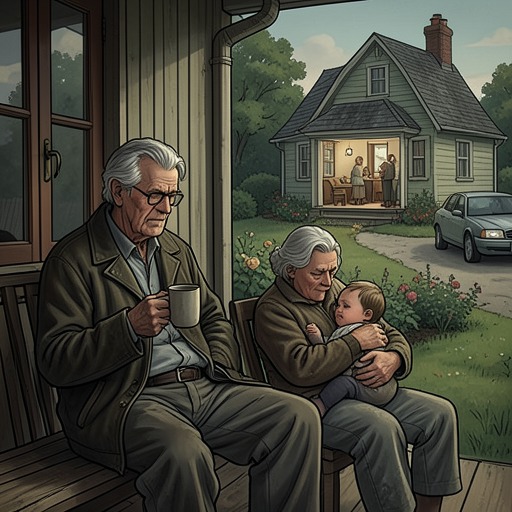
Katie's parents' house
Five Years Too Late: A Curvy Single Mom, Secret Baby, Second Chance Billionaire Romance (The CEO's Curvy Goddess)Katie's parents' house is the durable refuge at the foundation of Katie Moore's life story. It is not merely a childhood setting or a place of temporary residence: after Richard Cartright abandons Katie, the house becomes the base from which she survives pregnancy, raises Connor, builds a company, and later confronts the possibility that the past has returned. Its importance lies in the contrast between Katie's self-reliant public identity and the private, multigenerational support that made that independence possible.
Refuge After the Breakup
Katie's parents' house enters the story as a place of rescue after the breakup and the discovery of her pregnancy. Two months after Richard ends their relationship, Katie learns that she is pregnant, is only twenty-five, lacks a steady job, and is living paycheck to paycheck. Her parents respond without disappointment or pity. Her father tells her that they will help and that she may stay as long as necessary while she gets back on her feet, turning the house into a shelter from financial panic and social judgment.
The support is practical rather than merely sentimental. During Katie's pregnancy, and especially after Connor's birth, her parents carry much of the early childcare while she works. Katie works from home while caring for Connor, begins freelancing, accepts every job available, and eventually establishes an office. The house therefore functions as an informal care infrastructure: it gives Katie time, stability, and assistance while she performs both paid work and single motherhood. Her later success is presented as inseparable from this arrangement rather than as an achievement produced by individual effort alone.
The Foundation of Katie's Independence
Katie eventually moves out, but leaving the house does not mean leaving its influence. From the support her parents provide, she builds a business that grows from two employees to twenty in four years and takes corporate projects carrying six- or seven-figure retainers. Elsewhere, she describes building a million-dollar business from the ground up in five years, driven by the determination to create a secure life for Connor and to prove that Richard's diamonds could not purchase her dignity.
Her parents' house remains part of the economic history behind that achievement. Katie says that her parents helped finance the difficult beginning, cared for Connor while she found her footing, and absorbed the sacrifices required by her sudden circumstances. Once she succeeds, she repays that care by retiring them, buying them a pleasant house near her own, and ensuring that they never need to work again. The movement between homes thus traces a reversal of dependence: the parents first sustain Katie and Connor, and Katie later uses her success to secure their retirement.
Return When Richard Comes Back
Years later, Katie drives to her parents' house after Richard reappears in her life. Although she realizes that she has stopped at her parents' rather than her own home, the mistake reveals the house's emotional function: in crisis, it is still the place her instincts direct her. When her mother opens the door, Katie collapses into her arms and admits that Richard is back. Her mother immediately brings her inside and offers the same unconditional welcome that followed the pregnancy, allowing Katie to abandon the composure expected of a mother and successful businesswoman.
Inside the house, Katie voices the fear that Richard may discover Connor's existence and disrupt the child's life. She insists that Connor comes first and that she will leave immediately if she sees any sign of the old Richard. Her mother does not simply confirm Katie's anger. Instead, she suggests that the revelation may eventually produce something good, a response Katie finds cryptic and frustrating. The house becomes a space where Katie's protective certainty is questioned by someone who understands both her injury and her continuing attachment.
Maternal Counsel and Family Pressure
The house also stages the negotiation between Katie's defensive boundaries and her mother's belief in a second chance. When Katie tells her mother about going on a date with Richard, her mother reacts with unmistakable excitement but also acknowledges the harm Richard caused. She explains that Katie has spent years caring for Connor and supporting the family, and that she does not want Katie to remain alone. Her encouragement is grounded not in romantic fantasy alone but in concern for Katie's happiness after five years without a serious relationship.
Katie agrees to try, while establishing a firm condition: Connor will remain her first priority, and any return of Richard's former behavior will end the relationship. She leaves the house muttering an insult about her mother's manipulation as her mother's laughter follows her outside, but the scene turns the house into a place of affectionate pressure rather than passive consolation. Katie's mother does not make the decision for her; she pushes Katie to acknowledge that protection of Connor has also become a way to avoid the risk of being hurt again.
The same pattern recurs after the reunion has developed into a fragile pseudo-family arrangement. With Richard and Connor away at the park, Katie visits her parents and resists her mother's repeated insistence that she talk honestly with Richard. Her mother identifies the mutual longing that both adults are trying to conceal and argues that Katie has already given Connor two months to adjust to having a father. The house consequently serves as a family council chamber, where private avoidance is named aloud and the next emotional step is demanded.
A Multigenerational Alternative to Abandonment
Katie's parents' house carries special significance because it stands against the abandonment Richard represents. Richard's departure leaves Katie pregnant, economically vulnerable, and responsible for a child whose father does not know he exists. Her parents respond by taking her home, caring for her without judgment, helping with expenses and childcare, and supporting her business until she can establish security. Their house is therefore the material expression of a family system that absorbs crisis instead of passing it to the most vulnerable member.
That system also makes the eventual reconciliation possible. At the hospital, when Katie hands Connor to her mother before confronting Richard, the older woman remains part of the protective network surrounding mother and child. Katie's parents' house has already enabled Katie to raise Connor and build a successful life; it now provides the emotional background against which she can decide whether Richard may enter that life. When Katie and Richard finally recognize that, with Connor beside them, they have a chance to become the family they should have been, the house's earlier role becomes clear. It is the hidden foundation beneath the new family: a place of shelter, labor, counsel, and continuity that allows reconciliation to mean more than renewed romance.